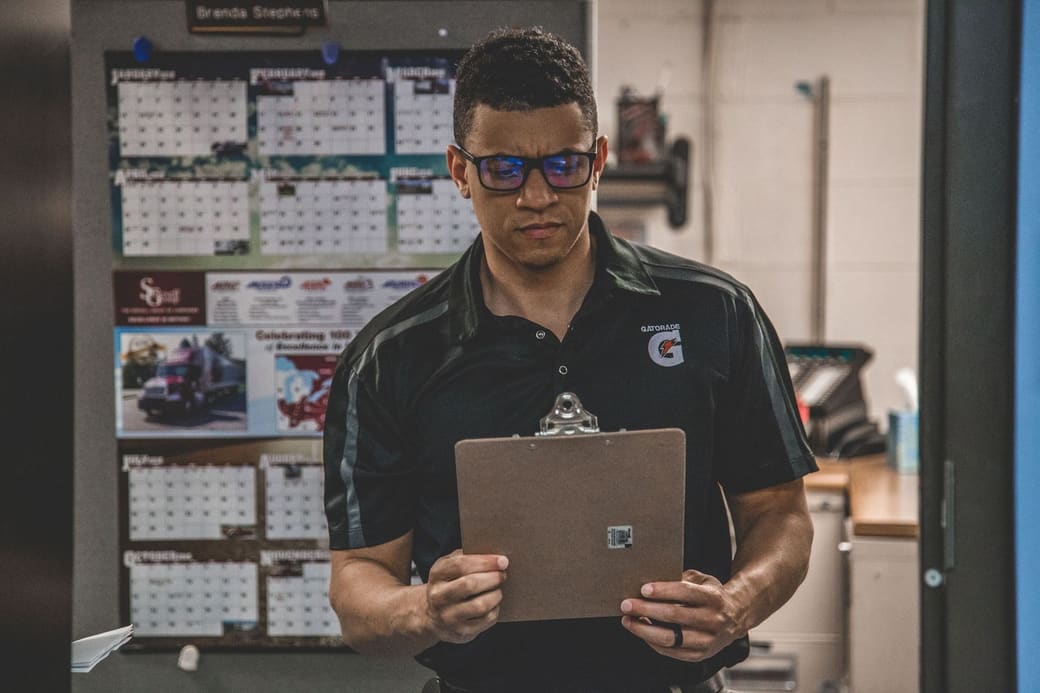
- The core task: supervise the activities of workers engaged in receiving, storing, testing, and shipping products or materials. It heads the task list in the next section.
- Typical entry education: high school diploma or equivalent. On-the-job training: none.
- Related work experience at entry: 5 years or more. On-the-job training: none.
- One certification applies: CLTD. CLTD is from Association for Supply Chain Management (ASCM).
- Median pay for transportation, storage and distribution managers: $107,230. The 10th to 90th percentiles run $65,120 to $194,900.
- Projected change through 2035: 6.1%. Annual openings: about 18,300.
A warehouse manager runs a building full of inventory and the people who move it. The Handbook describes warehouse, storage and distribution center managers as the managers who coordinate incoming and outgoing shipments, keep the facility clean and safe, and monitor and track inventory levels.
The job is closer to the floor than most management roles. The Handbook notes that in some warehouse operations a manager spends more time overseeing workers and has fewer budget responsibilities, which is the practical difference between this page and our supply chain manager page, where the work is setting strategy for the whole network.
The tasks O*NET rates most important for transportation, storage, and distribution managers:
- Supervise the activities of workers engaged in receiving, storing, testing, and shipping products or materials.
- Plan, develop, or implement warehouse safety and security programs and activities.
- Inspect physical conditions of warehouses, vehicle fleets, or equipment and order testing, maintenance, repairs, or replacements.
- Plan, organize, or manage the work of subordinate staff to ensure that the work is accomplished in a manner consistent with organizational requirements.
- Collaborate with other departments to integrate logistics with business systems or processes, such as customer sales, order management, accounting, or shipping.
- Analyze all aspects of corporate logistics to determine the most cost-effective or efficient means of transporting products or supplies.
Job titles in the same O*NET occupation: Distribution Center Manager, Distribution Manager, Fleet Manager, Global Transportation Manager, Logistics Director, Logistics Operations Manager, Shipping Manager, Supply Chain Logistics Manager, Transportation Manager and Warehouse Supervisor. Source: O*NET
OnLine, 11-3071.00, read 2026-09-23.
The Handbook describes warehouse, storage and distribution center managers as the people who oversee the operation of storage facilities, warehouses and distribution centers. The daily work is coordinating the incoming and outgoing shipments of products and materials, and keeping track of what is in the building.
The building itself is part of the job. These managers are responsible for keeping the facility clean and safe, monitoring and tracking inventory levels, and making sure staff and work practices follow safety policies and regulations. In some operations, the Handbook notes, a manager spends more time overseeing the workers inside the warehouse and has fewer budget responsibilities.
People management runs through all of it: planning and overseeing staff, hiring and scheduling training, evaluating work groups and looking for ways to make the operation more productive.
Main Responsibilities
- Coordinate incoming and outgoing shipments of products and materials
- Monitor and track inventory levels
- Keep the facility clean and safe, and staff practices within safety rules
- Plan, organize and oversee warehouse staff; hire and schedule training
- Find ways to raise productivity and operational efficiency
- Resolve problems with storage, shipments or clients
Who They Work With
The warehouse staff and first-line supervisors on the floor, and other departments such as sales and accounting, which the Handbook gives as examples of the departments these managers collaborate with.
Where And When They Work
The Handbook says these managers typically work in a warehouse or office setting. Most work full time and some more than forty hours; schedules can include nights, weekends and holidays, some are on call for emergencies, and warehouses can mean high-visibility vests and eye or ear protection.
The biggest employers of transportation, storage and distribution managers, by the Handbook's count:
transportation and warehousing (30%), wholesale trade (15%), manufacturing (13%), government, excluding state and local education and hospitals (8%) and management of companies and enterprises (7%).
Source: BLS Occupational Outlook Handbook, Transportation, Storage, and Distribution Managers, What They Do and Work Environment. Employer shares are of the occupation's jobs in 2025, from Employment Projections data, and include the self-employed. Read 2026-09-23.
BLS counts warehouse and distribution center managers inside transportation, storage and distribution managers, the same occupation behind our supply chain manager pages, so the occupation-wide figures here are shared with them. The warehousing figure below is this page’s own.
That is the same figure our supply chain manager career page shows, because it is the same occupation in BLS data.
Among transportation, storage and distribution managers working in warehousing and storage, which employs more of this occupation than any other, the median is
$99,330 a year across 21,430 jobs, with the 10th to 90th percentile running
$75,540 to $165,720.
Source: BLS OEWS, May 2025, national industry-specific
estimates. The figure is for transportation, storage and distribution managers working in that
industry, not for the job title alone. Read 2026-09-23.
Across all industries, the median for transportation, storage and distribution managers is $107,230 a year. The middle half
earns $82,440 to $146,770, and the full range runs from $65,120 at the 10th percentile to $194,900 at the 90th, across
221,180 jobs. The supply chain manager salary page breaks that down by state, metro area,
industry and employer type.
Source: BLS OEWS, May 2025, national. Read 2026-09-23.
Most warehouse managers are promoted into the role. The Handbook’s example is a hand laborer or material mover who becomes a first-line supervisor and then qualifies for storage and warehouse manager positions, and BLS lists years of related experience as typical for entry. A bachelor’s degree in supply chain management, logistics or business is what some employers prefer, and it is the faster route for someone starting outside the building.
What BLS Says Entry Takes
Typical entry requirements for Transportation, Storage, and Distribution Managers, BLS Employment Projections | Typical entry education | High school diploma or equivalent |
|---|
| Related work experience | 5 years or more |
|---|
| On-the-job training | None |
|---|
Several years of related work experience, which the Handbook says the occupation typically needs to enter; the amount varies by organization and industry. Employers may prefer a bachelor’s degree, and some require specific certifications or licenses.
Majors
Business, transportation or engineering, according to the Handbook, which also notes that some colleges offer bachelor’s programs in supply chain management and logistics.
Degree Levels That Lead In
CLTD is ASCM’s logistics credential, and its topics include warehouse and fulfillment center management directly.
Association for Supply Chain Management (ASCM)
CLTD: Certified in Logistics, Transportation and Distribution
Logistics specifically: logistics strategy, demand and capacity, customer and order management, warehouse and fulfillment center management, inventory, transportation, global logistics, reverse logistics and risk, and network design.
- Who It Is For
- People whose work is the movement and storage of goods: transportation, warehousing and fulfillment, order management and logistics network design, where the make, deliver and return steps of the supply chain meet.
- Eligibility
- None. ASCM sets no education or experience requirement; anyone can buy an authorization to test.
- Exam
- One exam of 150 questions (130 scored, 20 unscored pretest) in 3.5 hours, scored from 200 to 350, with 300 or more passing. It is taken at a Pearson VUE center or online. The content runs across nine modules.
- Cost
- ASCM lists the exam at $1,100 for members with its certification upgrade and $1,530 for everyone else.
- Renewal
- Stays valid while you earn 75 professional development points every five years. Holders aged 62 or older can convert a current certification to a lifetime designation, which ends the five-year maintenance cycle.
Source: ASCM, CLTD page, exam details, FAQs and exam handbook, read 2026-09-23.
ASCM membership is optional, though members pay less. You buy an authorization to test, which expires six months after purchase (12 months when bought in a bundle), and ASCM recommends about 100 hours of study per exam. A candidate who fails must wait 14 full days before retaking the same exam.
Sources: BLS Occupational Outlook Handbook, How to Become One; titles from
O*NET OnLine and the Handbook.
- Supply Chain Manager. The same BLS occupation; supply chain managers set strategy across the network the warehouse sits in.
- Transportation Manager. The same BLS occupation on the other side of the dock door: the Handbook lists both as types of this manager.
- Production Planner. Warehousing and storage is one of the largest industries employing production, planning, and expediting clerks in the OEWS data.
The qualities the Handbook names as important for transportation, storage and distribution managers:
- Leadership. Motivating staff while coordinating logistics operations.
- Organization. Keeping track of the many details of a facility.
- Problem-solving. Handling disruptions, staffing problems and client complaints.
- Time management. Keeping shipments that must happen in sequence on schedule.
O*NET lists the software the occupation uses and flags the technologies employers name most often in their job postings. For
transportation, storage, and distribution managers, the ones it marks as in demand are Microsoft Outlook, Microsoft Office software, Microsoft PowerPoint and Microsoft Excel.
Source: O*NET OnLine, 11-3071.00, Software Skills. "In demand" and "hot" are
O*NET's own flags, based on how often employers name the technology in job postings. Read 2026-09-23.
BLS projects employment of transportation, storage and distribution managers to grow 6.1% over 2025 to 2035,
from 228,100 to 242,100 jobs. That is faster than the 3.5% projected for all occupations.
BLS expects about 18,300 openings a year. Of those, 4,900 (27%)
replace people leaving the labor force, 12,000 (66%) replace people
moving to other occupations, and 1,400 (8%) are new jobs. The
supply chain manager salary page sets out what BLS says is driving demand.
Sources: BLS Employment Projections, 2025-35;
EP Table 1.10. New jobs is total openings minus
separations. Read 2026-09-23.
What Degree Do You Need To Be A Warehouse Manager?
BLS lists a high school diploma or equivalent as the typical entry education for transportation, storage and distribution managers.
How Long Does It Take To Become A Warehouse Manager?
BLS lists 5 years or more of related work experience as typical for entry, on top of a high school diploma. It is a job people are promoted into.
How Much Does A Warehouse Manager Make?
BLS counts warehouse and distribution center managers inside transportation, storage and distribution managers, the same occupation behind our supply chain manager pages, so the occupation-wide figures here are shared with them. The warehousing figure below is this page’s own. The median for transportation, storage and distribution managers is $107,230 a year (BLS OEWS, May 2025), with the 10th to 90th percentile running $65,120 to $194,900.
Is Warehouse Manager A Good Career?
On the federal numbers: a median of $107,230, and BLS projects the occupation to grow 6.1% from 2025 to 2035, against 3.5% for all occupations, with about 18,300 openings a year.
Can You Become A Warehouse Manager Without A Degree?
Yes. BLS lists a high school diploma as the typical entry education for the occupation, and the Handbook describes material movers moving up through supervisor roles. It also says employers may prefer a bachelor’s degree.
What Is The Difference Between A Warehouse Manager And A Supply Chain Manager?
Scope. BLS counts both in the same occupation, but a warehouse manager runs a building and its staff, while a supply chain manager sets the strategy for sourcing, storing and moving goods across the whole network.
What Software Do Warehouse Managers Use?
O*NET lists ERP systems such as SAP, inventory management software and spreadsheets among the tools of the occupation; the skills section above shows O*NET’s own demand flags.
Pay for transportation, storage and distribution managers by state, metro area and industry.
Runs the flow of goods from suppliers to customers: purchasing, inventory, warehousing and transportation under one set of targets.
Runs an organization’s transportation: the drivers, the fleet, the routes and the safety rules they operate under.
Programs read from each school’s own page, with tuition where the school states it.