What Is Cross Docking?
Where many drayage loads end up: a dock that sorts freight onto outbound trucks without storing it.
What Is Drayage
How a container gets from the ship to the warehouse by truck, what demurrage and detention charges are, what the federal billing rules say, and who does the work.
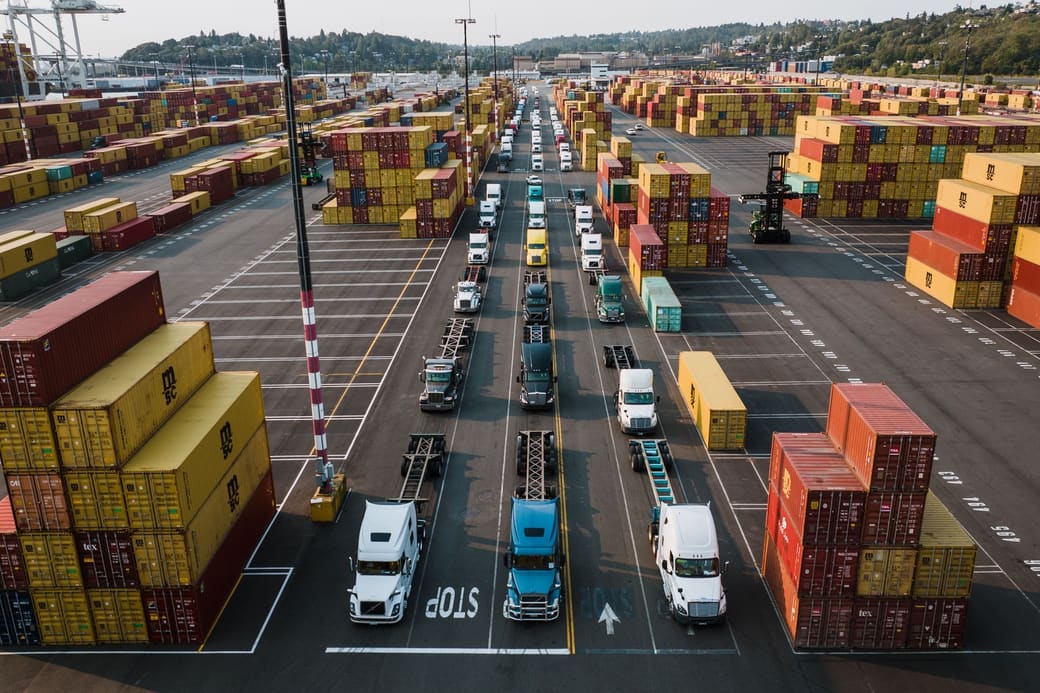
Drayage is the short truck move that carries a shipping container between a port or a rail terminal and a place nearby: a warehouse, a distribution center, a factory, or another terminal. When a container comes off a ship in Long Beach and goes to a warehouse in the Inland Empire, the truck trip in between is drayage. So is the trip that brings the empty back.
The word is old. A dray is “a strong cart or wagon without sides,” and Merriam-Webster defines drayage as “the work or cost of hauling by dray,” with a first known use in 1791. The horses are gone, but the meaning held: drayage is the short haul, and the word covers both the work and the price of it. You’ll hear it pronounced DRAY-ij.
There’s no federal industry code just for drayage. Most drayage carriers fall under what the Census Bureau calls general freight trucking, local, and its definition fits the work closely: “Local general freight trucking establishments usually provide trucking within a metropolitan area which may cross state lines. Generally the trips are same-day return.” A drayage driver who runs several containers a day between the port and warehouses a short drive inland is doing exactly that.
An import container’s drayage move runs in five steps. The order is the same at almost every US port:
Discharge Terminal
The ship is unloaded and the container goes into the terminal’s stacks. The terminal posts it as available once it clears customs and any holds.
Appointment Dispatcher
The drayage dispatcher books a pickup slot in the terminal’s appointment system and assigns a driver and a chassis.
Pickup Driver
The driver inspects the chassis, passes the gate, and has the container lifted onto it.
Delivery Driver
The load goes to a warehouse, a cross-dock or a rail ramp, usually inside the same metro area. Some customers unload while the driver waits; others take a dropped container.
Return Driver
The empty container goes back to the terminal or to a depot the carrier names, and the chassis goes back to its pool.
Two clocks start running during that sequence, and they’re the reason drayage gets so much attention from importers. One clock counts the days the container sits in the terminal. The other counts the days it spends outside before the empty comes back. Each has a number of days that cost nothing, called free time, and a daily charge after that. Those are demurrage and detention, covered below.
Export drayage runs the same loop backward. The driver takes an empty to the shipper, waits or comes back for the loaded box, and returns it to the terminal before the vessel’s cutoff. Who owns the goods while all this happens depends on the sale terms, not the truck: see FOB shipping point vs. FOB destination for how title and risk pass.
Carriers and brokers name drayage moves by where they start and end. The labels vary from company to company, but the moves don’t:
| Move | Runs Between | What To Know |
|---|---|---|
| Port to customer (import) | Marine terminal to a warehouse or distribution center | The most common move, and the one demurrage and detention bills follow. |
| Customer to port (export) | Shipper’s dock to the marine terminal | Has to hit the terminal’s earliest return date and the vessel cutoff. |
| Port to rail | Marine terminal to an intermodal rail ramp | Containers bound inland by train, when they don’t load on dock rail. |
| Rail to customer | Inland rail ramp to a warehouse | The same work at the other end of a train trip, hundreds of miles from the coast. |
| Terminal to terminal | Between two terminals or to an off-dock yard | Short moves to reposition boxes, empties or chassis. |
Some loads don’t go to the customer at all. Importers often have containers drayed to a nearby warehouse where the cargo is unloaded and reloaded into larger domestic trailers before the long haul inland. That handoff is transloading, and the cross docking guide explains how it differs from sorting freight at a cross-dock.
“Freight” is the goods and the business of moving them, so drayage is one kind of freight transportation, not an alternative to it. The useful comparison is with the long-haul trucking most people picture:
| Compared | Drayage | Long-Haul Trucking |
|---|---|---|
| Distance | Short, inside a metro area or to a nearby rail ramp | Hundreds of miles, often across states |
| Trip | Usually same-day, several loads a shift | One load over one or more days |
| Equipment | A tractor pulling a container on a chassis | A tractor pulling the carrier’s own dry van or reefer |
| Starts or ends at | A marine terminal or rail ramp | Shipper and receiver docks |
| What slows it | Terminal appointments, gate lines, chassis shortages | Hours-of-service limits and dock wait times |
| Extra charges | Demurrage, detention, chassis rental, port fees | Fuel surcharge, driver detention, lumper fees |
One word means different things on each side of that table. In trucking, “detention” usually means paying a driver who is kept waiting at a dock. In container shipping, detention is a charge for keeping the container. Ask which one an invoice means before you pay it.
A container has no wheels, so a drayage truck pulls it on a chassis, a steel frame with axles and locking pins. Federal motor carrier rules call the chassis intermodal equipment, defined in 49 CFR 390.5 as “trailing equipment that is used in the intermodal transportation of containers over public highways in interstate commerce, including trailers and chassis.” The chassis often belongs to a leasing pool or an equipment provider rather than the trucking company, which is why the rules put a duty on the driver at the moment of pickup.
Under 49 CFR 390.42, “Before operating intermodal equipment over the road, the driver accepting the equipment must inspect the equipment components.” Driving away counts as confirming those parts were in good order, so the inspection is the driver’s protection as much as the public’s. The list in 49 CFR 392.7(b) covers 9 items:
When the chassis comes back, the driver or carrier has to report any damage or defects they know about to the equipment provider. A bad chassis is also a common reason a container can’t be picked up on time, which feeds straight into the charges below.
Demurrage is a daily charge for a loaded container that stays in the terminal after its free time runs out. Detention, also called per diem, is a daily charge for a container that has left the terminal and hasn’t been returned after its free time. On an import, demurrage is the price of picking up late, and detention is the price of returning the empty late.
| Compared | Demurrage | Detention |
|---|---|---|
| Where the box is | Inside the terminal | Outside, with the trucker or the customer |
| Clock starts | When the container is available for pickup | When the container leaves the gate |
| Clock stops | When the container is picked up | When the empty is returned |
| Who bills it | The terminal or the ocean carrier | The ocean carrier that owns or leases the box |
Federal rules don’t split the two. The Federal Maritime Commission defines demurrage or detention together as “any charges, including “per diem” charges, assessed by ocean common carriers, marine terminal operators, or non-vessel-operating common carriers related to the use of marine terminal space (e.g., land) or shipping containers, but not including freight charges.” Its interpretive rule says the charges are supposed to work as “financial incentives to promote freight fluidity”: a push to keep boxes moving. That is why a charge for a container you couldn’t return, because the terminal wasn’t taking empties, is one the FMC says is likely unreasonable.
The Ocean Shipping Reform Act of 2022 told the FMC to write billing rules, and the result is 46 CFR part 541, published February 26, 2024. It covers invoices from ocean carriers, marine terminal operators and NVOCCs. Three deadlines do most of the work:
The invoice itself has to carry the bill of lading and container numbers, the rate and the tariff or contract rule behind it, a contact for disputes, and certifications that the charges follow FMC rules and that the biller didn’t cause them. It also has to show the dates the charge depends on:
Leaving any required item off isn’t a technicality. The rule says a missing item “eliminates any obligation of the billed party to pay the applicable charge.” For anyone paying these bills, checking each invoice against that list is the first step of every dispute.
What changed in 2025. The original rule also said who could be billed, and it barred billing motor carriers. Ocean carriers challenged it, and on September 23, 2025, in World Shipping Council v. Federal Maritime Commission, the D.C. Circuit set that section aside, finding no explanation for a “categorical bar against billing motor carriers even when in privity with the billing party.” The FMC removed 46 CFR 541.4 on December 29, 2025. The rest of the rule stands. So a drayage carrier can now be billed when its contract makes it responsible, and every invoice still has to state “The basis for why the billed party is the proper party of interest and thus liable for the charge.”
If a charge looks wrong, the law gives you a lever. Under 46 U.S.C. 41310, anyone can send the FMC a charge complaint, and the carrier must “bear[s] the burden of establishing the reasonableness of any demurrage or detention charges.” A rule effective September 1, 2026 added that a charge complaint can also be filed as a formal case before an administrative law judge or a small claims officer, with the same burden on the carrier.
Demurrage and detention are usually billed in tiers: a daily rate for the first few chargeable days, then a higher one, then higher again. Enter your free time, how long the container was held, and the rates from your tariff or contract. The starting numbers are an invented example, not any carrier’s or terminal’s rates.
In the example, 4 days of free time and a container held 9 days leaves 5 chargeable days, and the total is $850. The tiers are why a container that slips a few extra days costs far more than the first late day suggests.
The Port of Los Angeles publishes its container counts each month, and they show how much drayage a big port generates. In October 2026 it handled 1,026,872 twenty-foot equivalent units (TEUs), +21% on October 2025:
| Containers | October 2026 | October 2025 | Change |
|---|---|---|---|
| Loaded imports | 538,620 | 429,280 | +25% |
| Loaded exports | 114,981 | 123,764 | -7% |
| Empty containers | 373,271 | 295,380 | +26% |
| Total | 1,026,872 | 848,424 | +21% |
Port of Los Angeles container statistics, in TEUs, rounded to whole units.
Loaded imports rose 25% while loaded exports fell 7%, and empties rose 26%. Empty containers were 36% of the month’s volume. That matters for drayage because an empty still has to be moved: when imports outrun exports, many import boxes go back to the terminal empty, to be shipped out empty, and detention runs on each one until it’s returned.
Port of Los Angeles, TEUs a year 2016 to 2025
The port also charges for the trucks themselves. Its Clean Truck Fund rate is $10 per TEU on loaded containers moved by nonexempt trucks, set in March 2020 with the Port of Long Beach and collected since April 1, 2022, toward a zero-emission truck fleet by 2035. Zero-emission trucks are exempt, and low-NOx trucks registered by December 31, 2022 are exempt until December 31, 2027. The port is explicit about who pays: “The cost is paid by cargo owners or their agents on loaded containers moved by truck.” and “The Port Tariff language specifically states that the CTF Rate cannot be paid by truck drivers.”
Drayage drivers work either as employees of a carrier or as owner-operators, who own their trucks and contract with one. California requires ports moving more than a million TEUs a year to survey their carriers on that split every two years, and the Port of Los Angeles surveyed the licensed motor carriers serving it from September 12 to October 22, 2024. Of 156 carriers that answered, 77 said they use no independent contractors at all, while 18 said they have no employee drivers:
Carriers serving the Port of Los Angeles, by number of drivers count of the 156 carriers that answered
The largest group, 53 carriers, reported one to five employee drivers, the most common size band. The survey counts carriers rather than drivers, so it can’t say what share of all port drivers are contractors. What it shows is that a drayage driver looking for work at this port has both models to choose from.
BLS counts jobs in local general freight trucking, the industry most drayage carriers sit in, every month. It employed 278,300 people in July 2026, up 13% from 246,300 in July 2016, but down from its 2023 peak of 296,600. The count covers all local freight trucking, not only port work.
| 2016 | 2017 | 2018 | 2019 | 2020 | 2021 | 2022 | 2023 | 2024 | 2025 | 2026 |
|---|---|---|---|---|---|---|---|---|---|---|
| 246,300 | 248,700 | 260,300 | 268,800 | 262,900 | 285,800 | 295,900 | 296,600 | 289,900 | 280,300 | 278,300 |
BLS Current Employment Statistics, all employees, seasonally adjusted, series CES4348411001, July of each year.
Behind every drayage move is a dispatcher juggling terminal appointments, a customer service or freight agent tracking free time, and managers who decide how many trucks and chassis to run. These are the jobs and what BLS says each pays nationally:
Heavy and tractor-trailer truck drivers Pull the container between the port, the rail ramp and the customer
$40,140$58,640 median$79,380
Dispatchers Book terminal appointments and assign each container to a driver
$36,030$50,340 median$78,140
Cargo and freight agents Arrange the move and handle the paperwork for the shipper
$38,340$52,260 median$79,810
Transportation, storage and distribution managers Run a drayage terminal, a fleet or a port operation
$65,120$107,230 median$194,900
Where you work changes the number. Heavy truck drivers in truck transportation earn a median $60,320, above the $58,640 for the occupation, while those employed by support activities for transportation earn $49,320. Dispatchers in truck transportation earn $57,010, against $50,340 across all industries. Transportation and distribution managers at port support firms, the industry that includes marine terminals, earn a median $154,510, against $98,800 for those in trucking.
Driving takes a commercial driver’s license, not a degree. The planning and management jobs are where a degree comes in. Demurrage exposure, chassis supply and port congestion are now line items that a logistician or a transportation manager is expected to manage, and they are core material in a logistics major. If that work appeals to you, start with what logistics covers, then compare the programs in the logistics degree rankings.
Drayage is the short truck move that takes a container from a port or rail terminal to a nearby warehouse, or the reverse. The word comes from the dray, a sideless cart, and Merriam-Webster still defines drayage as the work or cost of hauling by dray.
DRAY-ij, two syllables, rhyming with “stay” plus the end of “bridge.” Merriam-Webster gives ˈdrā-ij.
Drayage is a kind of trucking. It is short, usually inside one metro area, moves sealed containers on a chassis, and starts or ends at a port or rail terminal. Other truckload and less-than-truckload work runs longer distances in the carrier’s own trailers.
Both are daily charges for keeping a container past its free time. Demurrage covers the time a loaded container sits in the terminal. Detention, also called per diem, covers the time a container is out of the terminal until the empty comes back.
The shipper or consignee who hired the move pays for drayage, directly or through a forwarder. Demurrage and detention go to whoever the carrier’s contract makes responsible, and since the 2025 court ruling the federal rule no longer bars billing a trucker. The invoice must say why the billed party is the one liable.
Where many drayage loads end up: a dock that sorts freight onto outbound trucks without storing it.
How much cargo fits in the 20-foot, 40-foot and high cube containers a drayage truck pulls.
The management job over a fleet or a terminal, and the experience it takes.
The bachelor’s and master’s programs named for logistics, ranked.